
How Film Composing Has Evolved from 2000 to 2025
From rooms full of hardware to laptops and Atmos mixes, film composing has evolved from analog workflows to hybrid, collaborative, always-on creation. Today’s film composer is part producer, part sound designer, and part partner to creators across streaming, games, and social.
2000s: DAWs Democratize the Art of Composing
-
- DAWs + sample libraries (Logic, Pro Tools, later Cubase/Studio One) made realistic mockups standard.
- Big-screen symphonic sound stayed strong (think John Williams), while hybrid textures rose (e.g., Hans Zimmer’s layered, processed palettes).
- Deliverable expectations expanded from a stereo film score to alt versions, stems, and tight sync edits, key for modern scoring music.
2010s: Streaming Changes the Job
-
- Series storytelling exploded. Composers built themes that evolve episode to episode (e.g., Ramin Djawadi’s long-form arcs).
- Sonic identities got bolder and more personal, Ludwig Göransson’s The Mandalorian popularized characterful timbres (hello, bass recorder + modular).
- Distribution shifted: soundtracks became standalone listening on Spotify/Apple, so cues had to live both to picture and as albums.
2020–2025: Remote, Realtime & Immersive
-
- Remote collaboration went from backup plan to baseline, shared sessions, versioned cues, cloud instruments.
- Immersive formats (Dolby Atmos/Spatial Audio) changed arranging: vertical space matters, not just left/right.
- Cross-media skills are expected: composing for film, games, podcasts, trailers, shorts, same composer, different storytelling rules.
- AI moved from headline to helper (see below), speeding sketching and sound design while the human stays in the driver’s seat.
Collaboration Looks Different Now
-
- Creators and music composers iterate faster: temp cues, screen shares, and comment-to-bar timestamps.
- Clear briefs and revision caps prevent “endless v3.12.” (On Compozly, milestones + escrow keep both sides safe and focused.)
Education & Access Widened
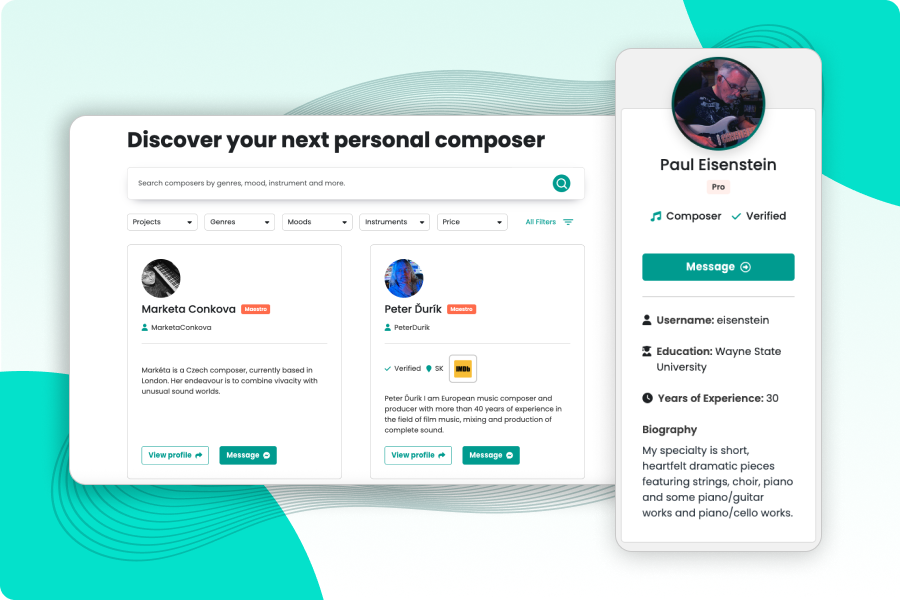
World-class training is online; portfolios live on YouTube/Vimeo; discovery happens on platforms like Compozly’s Discover, where your profile, reels (SoundCloud sets, YouTube), and credits do the talking.
Indie Heat & Signature Sound
-
- Independent films and series invite risk: processed acoustics, modular synths, boutique ensembles, found sounds.
- Collabs like M83 + Joseph Trapanese on Oblivion showed how electronic and orchestral languages fuse without losing narrative clarity.

AI: assistant TO THE regional manager, not manager…
For working composers, the most productive way to think about artificial intelligence is less as a substitute for authorship and more as a studio assistant that happens to be lightning fast; in practice, that looks like using AI to spin out rough sketches, coloristic textures, or MIDI seedlings that can nudge you past the blank page, after which you do the real work, rewriting themes so they carry character, orchestrating for impact and clarity, and performing or shaping parts until the cue feels undeniably human. In other words, AI can widen the starting lane for scoring music, but the choices that make a film score breathe, motivic development, timing against picture, silence versus saturation, still live with the movie composer whose judgement ties sound to story.
Because these tools now sit inside everyday workflows, ethics can’t be an afterthought; originality, dataset provenance, and licensing remain the composer’s responsibility, and that means knowing what your tools allow, declining “style cloning” requests that cross the line, and delivering music that you can license cleanly and defend confidently. Clients hire you for taste, not for presets, so it pays to be transparent about your process, to document versions and approvals, and to ensure that credits reflect the human authorship at the heart of the art of composing, no matter how clever the algorithms get.

Looking ahead, the canvas for composing for film and adjacent media is only getting bigger and more interactive: AR and VR experiences, story-driven games, and hybrid live/digital events will ask for music that adapts in real time, which pushes composers to design themes as systems rather than single, fixed recordings. At the same time, faster turnarounds are likely to become the norm, so resilient pipelines, clean session templates, stem-first arranging, Atmos-aware mixes, and version control, will separate the frantic from the professional, while stronger sonic identities will matter more than ever in a crowded landscape where recognizable voice beats generic polish. Perhaps most encouraging, the circle of who gets heard continues to widen; as access improves and gatekeeping loosens, a broader mix of music composers and storytellers will shape what mainstream film music sounds like, and that diversity will keep the medium fresh.

Quick Recap
-
- Role of AI: use it to draft sketches and textures, then rewrite, orchestrate, and humanize.
- Ethics: protect originality, verify data sources, and keep licensing clean and credited to you.
- What’s next: adaptive scores for AR/VR and games, faster timelines with smarter pipelines, and more inclusive voices reshaping the sound of screen stories.
Ready to find work and collaborators? Build your Compozly profile (SoundCloud sets, YouTube, IMDb), show up in Compozly’s Discover page, and land real music composer jobs, with escrowed payments and clear licensing.
Take your composing career to the next level
Create your free account to access new features. Get Started
© 2025 Compozly, LLC ALL RIGHTS RESERVED